Pages

Showing posts with label fish farming. Show all posts

Friday, October 16, 2015

The Future of Aquaponics And The Need For Certification

Trinidad State College And Future Aquaponic Classes


With the USDA now looking into the certification of classifying aquaponics an organic food, there are also other questions being raised whether or not the legalities can actually be changed. 

You see aquaponics is not just about growing organic foods but also raising healthy fish. While there are some fantastic teachers in the aquaponics industry how many of them actually have a certification in fish diseases and or the proper care and treatment for sick fish?

For many people this might seem like we are splitting hairs but if you do not go to school to get a degree-certification in aquaculture, the disease issue could become a real problem at some point.

Stress is still the biggest contributor to disease forming in fish and people in the aquaculture industry who are breeding, raising and farming fish are already aware of these problems.


USDA Taskforce


A task force has now been assigned from USDA and they will be looking into every aspect of the aquaponics industry. Does this mean there will be certifications, licensing and more restrictions once everything is reviewed? The fact is people might have to get ready for some big industry changes and once the new regulations are set in place, that could mean good news or not for current aquaponic farms. 

My thoughts are if the USDA was to give an organic certification to the aquaponics industry, it should include a good knowledge base concerning some of the diseases fish can carry onto humans. 
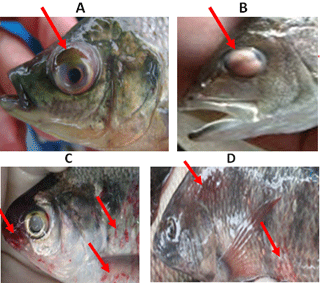

Picture Source Mad Fish Disease: 


Fish TB (MYCOBACTERIUM MARINUM), also called fish tuberculosis, fish tank granuloma, swimming pool granuloma. Related to human TB and leprosy.

MAD FISH DISEASE ... caused by STREPTOCOCCUS INIAE.
Recently reported from handling tilapia. Infection via puncture wounds.

SALMONELLA... over 1600 serotypes identified.
Infection by ingestion. Carried by many types of animals.

ERYSIPELOTHRIX RHUSIOPATHIAE, also known as erythema migrans, fish-handler's disease, fish poisoning, fish hand, sealer's finger, whale finger, blubber finger, etc.

VIBRIO infections. Several species can infect humans: V. ALGINOLYTICUS (wound infections), V.DAMSELA (wound/systemic infections), V. PARAHAEMOLYTICUS (gastroenteritis/wound infections),V.VULNIFICUS (wound/gastroenteritis/systemic infections). 


The below points are valid causes for concern for the USDA and why we believe that colleges will eventually play a more significant role in the certification and education process of aquaponics.


• Careful selection of sites for aquaculture farms. 

• Protection of adjacent ecosystems. 

• Active avoidance of conflicts with other users of the aquatic resources (e.g., fishermen) 

• Prohibition of chemicals (e.g.. as anti-fouling agents in net pens) . 

• Natural remedies and treatments in the case of disease. 

• Feedstuff from organic agriculture. 

• Fishmeal and - oil in feed derived from by-products of fish processed for human consumption (no dedicated "feed fishery"). 

• Prohibition of GMOs, neither in feedstuff, nor in the stock itself. 

• Processing according to organic standards. 

"According to a Consumer Reports magazine food labeling poll, some 74 percent of consumers are concerned about environmental pollution from “organic” fish. The poll also showed that 91 percent of consumers want contaminants in fish to be absent or present only at very low levels." See more information at the link below... 


Trinidad State College


The Trinidad State College in Colorado has a fantastic aquaculture program running, where they offer a 2 year accredited degree. They now want to expand their curriculum into an aquaponics certification and the ASC Magazine has been asked to contribute coursework to this process. We have a team of great writers who will be helping out and making suggestions to aid in the perfection of this aquaponic coursework. 


We are proud and happy to help out the college and we believe this is the right course of action in furthering the education process regarding the future of aquaponics.

If you would like to join the magazine please check out our main subscription page below: 


Cheers 

Victoria

Tuesday, August 25, 2015

Aquaponic Abundance with the ASC Magazine

Aqua Abundance and Spencer Curry


Spencer Curry is an owner-operator with Fresh Farm Aquaponics. He is also a writer for the ASC Magazine. Spencer's articles come with a lot of enthusiasm and love for this industry. We are very proud to feature this column in our magazine every month. Spencer is showing people of all ages what can be done with all of that youth and energy. We think he is quite a remarkable young man. 


Hi everyone welcome back to Aquaponic Abundance!

Article taken from the ASC Magazine March 2015

Last time we talked we went over the specific winter techniques that I’m using on my farm, FRESH Farm Aquaponics.  We're located in South Glastonbury, Connecticut.  

Currently we have more than a couple feet of snow piled up around our greenhouse.  Despite night temperatures well below freezing, our 25 koi are happily swimming in balmy 65 degrees water with daily air temperatures of 75-80℉.

We went over how we heat the water (with a Jacuzzi heater), our mini-greenhouses, and the lights we use to accelerate growth during the darker months.  Be sure to check out last month’s article for more information.

This month the light starts to come back and the days grow longer.  Our plants are starting to perk up and grow, little by little.  

The aquaponics system is a marvelous tool for season extension.  Even without using grow lights, there are a number of benefits to starting your season off early with an aquaponics system.

Season Extension with Aquaponics


There are many reasons aquaponics is so wonderful for season extension.  Aquaponics systems use heat more efficiently, the growing media is always workable and they make use of the little light available most effectively.

Most farmers in our region are busy hibernating at this time of the year.  Fields are under thick blankets of snow.  Greenhouses are expensive to heat the traditional way, most farmers around here use wood boilers or oil burning ovens to keep their greenhouse air warm.  

But as we covered in the last article, it is far more cost-effective to heat the water in the aquaponics system than heating the air in a normal greenhouse.  For one, the heat from the water eventually radiates up to the plants leaves.  

This is similar to how the heat of the Earth normally radiates up from the soil into the undercarriage of the plants.  By heating the water, you heat the roots and plants and the air, all at a fraction of the cost of heating the air by itself!

Eager to get planting but held back by a snowy March?

Luckily, aquaponics growing media is also always workable.  The growing medium never freezes.  There is no need to wait for soil to thaw out.  There is no need to shovel snow or wait for it to melt.  

No need to battle early spring weeds or any of the other headaches typically associated with working the land after a hard winter.  That means that you can get your plants in the ground as soon as the seedlings are ready.  

Finally, aquaponics provides such a rich environment to your new seedlings that they are able to best utilize whatever light there is available in these early months.  In normal soil conditions, plant roots must expend energy on extending themselves throughout the soil in search of nutrients.  

However in aquaponics, the roots are flooded with vital nutrients, water, and beneficial bacteria.


There is no need to expend resources on root growth, so all energy is directed to actual plant growth. When a plant has so much of its needs cared for, the only limiting factor is the light.  That means that whatever light is available, your aquaponics systems will make the best of it!

If you would like to read more about the Aqua Abundance Article...

Subscribe to the magazine by purchasing a lifetime subscription here: 


OR

You can purchase all the back issues of the ASC Magazine here:


Saturday, August 22, 2015

Best Seeds With The ASC Magazine

Whats the difference between Open Pollinated, Hybrid and Heirloom?


Taken from the ASC Magazine August Edition 2013

Tom introduced a discussion detailing characteristics of hybrid seeds. As we all consider varieties for the season, it is common to wonder about the difference between hybrid and open-pollinated varieties when choosing varieties that are right for you. First, let’s make sure we’re all speaking the same language. 


Open-Pollinated Varieties 


Are those, which if properly isolated from other varieties in the same plant species, will produce seed that is genetically “true to type.” This means that the seed will result in a plant very similar to the parent. Beginning in the early 1900s, plant breeders worked to develop new open-pollinated varieties, using techniques to create a more pure, and thus uniform, genetic line. 


Heirloom Varieties 

Are named open-pollinated strains which either pre-date or are unaltered by the earliest open-pollinated breeding work. If open-pollinated varieties are allowed to cross within the same species, the resulting seed will be a hybrid.  

The modern era of plant breeding started when biologists rediscovered Gregor Mendel’s study of genetics. By the 1930s, many hybrid sweet corn varieties were available in the US. 


Hybrids

In commercial seed production, hybrids come from the careful and deliberate crossing of two different parent varieties, each with traits desired for the offspring. Seed from a hybrid variety can be saved, but will not be true to type.

At High Mowing Organic Seeds, we are of the opinion that both open-pollinated and hybrid varieties deserve a seat at the table. As discussed below, each has its benefits: 

The Benefits of Open-Pollinated Varieties

Save your seed: The most obvious benefit to using open-pollinated seeds is the option to produce one’s own seed supply. Some crops, including beans, peas, tomatoes, and lettuce, are self-pollinating, and thus do not even require much isolation for seed saving. Furthermore, by selecting the best plants from which to save seed, anyone can adapt specific variety strains to their region or microclimate. 

Less Costly: For a number of reasons, open-pollinated seeds are invariably less expensive than hybrid varieties. For every hybrid, there are actually two distinct lines of genetics that must be maintained, not to mention the careful task of production, which can get quite costly.

Flavor: Few can ignore the superior flavor of many open-pollinated varieties. Many breeders who specialize in creating hybrid varieties for large-scale commercial growers tend to focus on qualities other than flavor, such as storage ability, uniformity, and characteristics more pertinent to processing. Suffice it to say that since the onset of modern hybrid plant breeding, flavor has not been a priority. 

If you would like to read more about this article...

You can purchase all the back issues of the ASC Magazine here:


Or 

Subscribe to the magazine by purchasing a lifetime subscription here: 


Thursday, August 20, 2015

ASC Aquaponics Magazine And Evergreen Aqua

Evergreen Aquaponics With Sasha Grove


Many people in our society are just beginning to acknowledge the detriment the industrialized food system has been to our health and food security. Foods grown in depleted soils, from suspect seed, treated with chemicals and preservatives, trucked enormous distances to the final destination on the family table, are contributing in unfortunate ways to the health of our nation. The current economic climate is restricting the choices of the average family by limiting their available resources for quality foods.

A widespread economic crisis could lead to mass food shortages. Aquaponics can be part of the solution for access to quality food and will enhance health and food security of the family and local communities.

While there are many proposed solutions to the ever increasing threat of obesity and chronic disease, the greatest impact can come from the food we feed our families. Many families are seeking to know what steps to take to become healthier. An obstacle to deciding on a course of action is the conflicting agenda driven information about nutrition coming from so many directions. 

Yet, it is generally agreed that sugar and other refined carbohydrates such as white flour are a major culprit leading to obesity. Whole grains, fresh fruits and vegetables and moderate amounts of meat based foods are necessary for a healthy diet.


The plan to avoid many nutritional pitfalls it derailed as we realize the near impossibility of avoiding canned and other prepackaged foods at the supermarket, which often list sugar or even corn syrup as one of the top ingredients, as well as numerous chemicals and preservatives. We assume that purchasing as much fresh food possible will be enough. Yet, even this can be and inadequate solution. The average distance food travels to get to your dinner table is 1800 miles. Much of this produce has been treated with chemicals or other preservatives, for the purpose of enhancing its ability to stay firm and colorful long past its normal shelf life. The nutrients that were in the plant when it was harvested have been significantly reduced.

As families become more and more concerned with the quality and availability of their food supply, home gardening is making a comeback. Home gardening has always been an American tradition.

If you would like to read more about this article...

You can purchase all the back issues of the ASC Magazine here:


Or 

Subscribe to the magazine by purchasing a lifetime subscription here: 


Wednesday, August 19, 2015

Technology With Aquaponics ASC Magazine

The  APDuino Project Written By AndrĂ¡s Schreiber


In agriculture the quality and quantity of crops greatly depend on the environmental conditions. In traditional agriculture we can make little impact on most factors. Even if we can make an impact, we often make things worse: just think about all the unnecessary fertilization poisoning underground waters or pesticides poisoning all the bugs most likely playing an important part of the natural cycle.

Fortunately there are new growing techniques (some may be ancient or rediscovered), hydro-cultures, such as Aquaponics that are pointing towards a possible solution for several problems and beyond...

Greenhouses and urban growing conditions (window farms, growing cabinets, etc) are getting more and more spotlight and gaining popularity across the globe, especially as there is an exponentially increasing awareness of global problems. Hydro-culture could also answer challenges of places where water is the most precious resource of all.

In closed systems, however, specifically, it is possible to have a tight control on the environment. Theoretically it is possible to maintain an ideal environment for the exact flora and fauna hosted in the closed environment.

Maintenance of an optimal environment takes effort, tedious execution of checks and prompt actions is needed to balance out changes in the external and or internal conditions and ensure avoidance of stressful imbalances.


Project Goal

The APDuino Project aims to provide aid in automation for the pioneering aquaponics and hydroponics farmers, enthusiasts, researchers in a way that even less technical knowledge is required to build a microcontroller-based automation system than before, whereas unlimited complex computing power is fitted to it through the ubiquitous computing already present: the Internet.

Project output, high-level technical overview


The project produces free, open-source binaries for the popular Arduino Mega 2560 + W5100 EtherShield (or equivalent clones) hardware combo, as a basis for any Node. 

Nodes can host many kinds of sensors and actuators, making it possible to monitor environmental conditions such as temperature, humidity, light, conductivity, pressure, water quality, etc. and to interact with the environment by controlling appliances like lights, pumps, heaters, coolers, etc. 

Nodes can be wired and configured according to the individual needs and specifications, within the constraints of hardware datasheets and software support. The reference hardware is low cost and widely available and known to aquaponics + arduino enthusiasts. Already several systems have been created based on them prior to APDuino Project, but in a less flexible (if open at all), less adaptable design and implementation.

Besides the official Arduino site and forum, there are tons of blogs, how-to’s, forums and companies providing excellent, reliable documentation on how to wire up the hardware components. 

Again, the key difference with APDuino Project is that those programming parts can be skipped; supported hardware can be configured using APDuino Online.

Nodes provide a web-based graphical user interface with charts and interaction with the device; switch between open and closed-loop control, change actuator states, etc.

Key Features:
• No-coding needed to fit supported sensors, actuators
• Closed-loop control (automation) based on custom, user provided logic
• Offline and online data logging
• HTTP API for LAN applications
• Free, open-source

If you would like to read more regarding this article...


You can purchase all the back issues of the ASC Magazine here:


Or 

Subscribe to the magazine by purchasing a lifetime subscription here: 


Monday, August 17, 2015

Josh Goode Talks To ASC Aquaponics Magazine

Sweet Home Aquaponics Meet Josh Goode


"Simplicity Is The Ultimate Sophistication." -Leonardo DaVinci

I learned in my work in aquaponics that a simple design is always the best. We see wonderful production and balance in a natural pond environment, thriving with fish and plant life. It's a beautiful sight to see a pond with a waterfall flowing fresh and oxygenated water for the fish and creatures that call it home. And let's not forget the abundance of plant life that grows outward from these pond ecosystems.

Out in nature when we find a thriving ecosystem and peel away the layers to find its source, this source being the re-circulating and recycling layered systems found near a waterfall and pond. 

The recycling abilities of living things working together in perfection. Fish and microbes producing and recycling waste along with all the plant life absorbing and further recycling so there is no more waste and a perfect balance is maintained...with food for all.

One thing I love about aquaponics is that we borrow that magic found in a pond environment and simplify it down into a platform to grow food for us. There are many designs that have been successful in aquaponics, my thought was to design an aquaponics system that is mostly automated and user-friendly. 

A design that someone with light construction skills can build themselves and most materials can be found locally. Then give the platform the ability to be "off the grid" and powered by the sun, replenished by the rain, and protected from all the hordes of critters out there. This article is about one of my favorite designs in aquaponics, the Solar Aquaponic Greenhouse.

The design is basic wood frame construction with pond liners for water-proofing, materials that can mostly be found at your local home improvement store. The pond is the base of the system with about 18 inches of water and a thin gravel layer along the bottom. The system in the photos is 8 feet long by 2 feet wide, so the pond when full of water is about 120 gallons. A good fish ratio is 1 fish per 10 gallons of pond water. So I put 12 Tilapia in the pond to get it started. Then a submersible water pump placed at the bottom of the pond will pump the water to the grow-bed above, bringing nutrient rich pond water to the plants. 


Bacteria break down the fish effluent and releases molecules that are then absorbed by the plants. Then the filtered water drains back into the pond, simulating a waterfall and oxygenating the pond water for the fish.

A small aquarium air pump with an air strip on the bottom of the pond provides further oxygenation for the fish. These two pumps are the only electronics needed to run the system and are powered by a solar panel/boat battery/inverter kit. These components are housed inside a small cabinet below the grow-bed to provide protection from the sun and elements. The solar panel charges a marine battery, a 500 watt power inverter is connected to the battery, and then both the water pump and air pump are plugged into the inverter, each with a simple 30 minute mechanical timer.

If you would like to read more about Josh's story and his cool aquaponics system, we have his full article in the May 2013 Edition of the ASC Magazine. 

You can purchase all the back issues here:


Or 

Subscribe to the magazine by purchasing a lifetime subscription here: 

Thursday, August 13, 2015

Growing And Aquaponics Survival Communities Magazine

Learning From The Past To Carry On Into The Future

When the ASC Magazine first came out in March of 2013, we started off with community members contributing stories about growing through aquaponics and soil grown foods. We were extremely happy with the different responses from local people who had an eagerness to write about their growing experiences. We didn't care which part of the world you lived in because by telling your story, there was that camaraderie to help other people. 

Since that time 2.5 years ago, the average person has become painfully aware of the need to grow their own food because of preservatives, additives, glyphosate, fluoride, ethoxyquin and other chemicals being found in our food and water. 

While some people have the knowledge and skills to grow just about anything they can, other people still need to learn and this is where our magazine comes into play. I personally have found some of the best lessons in growing come from people who tinker around in their backyards or greenhouses. 

It takes all kinds of people to grow food anywhere they can and there are many great lessons that can be taught from local people. These are community members willing to step up and help others learn. For many good reasons this is probably where food in the future will be headed. 

More people now realize big agriculture has become a dominant and greedy eyesore on the landscape, so they want the knowledge in how to grow their own food.

We have become very aware the food we are eating from grocery stores is less nutritious and more chemical laden, so it will be the local people, backyard tinkerers and community growers who will be teachers for the future.

People desperately want safe, toxic free, naturally grown foods to eat and they know big Agro is NOT giving it to them. When you have the backing of congress supporting big Pharma and big Agro, it makes the decision to grow your own food a whole lot easier.

In all seriousness folks, I don't know anyone who wants to eat food laced with poisons. Do you? 


That's why the ASC Magazine is so important for everyone. We promote local growers, local teachers and community leaders. 


Here is a story from our very first edition about a teacher named Bryan Vincent King who is doing this very thing with his students. He happily became an Urban Farmer and his students have benefitted immensely through his knowledge.  


So have you become a part of the ASC Magazine yet? 

Below is a link to the lifetime subscription. It's a ONE TIME Fee and then you receive in your mailbox on the 10th of every month, a magazine teaching you how to grow through aquaponics, permaculture, agroforestry and other viable methods of growing SAFE, pesticide free, FOOD.  


If you would rather not subscribe but would like to purchase back issues you can do that as well: 


The ASC Magazine believes in paying it forward to benefit all people. This also means businesses, schools, educators and the awesome backyard growers. 

"Pay it forward is an expression for describing the beneficiary of a good deed repaying it to others instead of to the original benefactor. The concept is old, but the phrase may have been coined by Lily Hardy Hammond in her 1916 book In the Garden of Delight."

So what does that mean to you? Well I suppose that is up to you...tell us your story because we listen and then we publish your article to other people. They will read what you have to say and will be inspired by it and possibly teach your skills to someone else. Get involved and pay it forward...


Brightest Blessings

Victoria Kelley


Saturday, August 8, 2015

Aquaponics Photo Contest

Aquaponics Backyard - Commercial System Contest

This is a MONTHLY contest and our aim is to raise awareness of people just like you, creating all kinds of aqua systems, and sharing real people and their Aqua growing experiences.

From the smallest to massive commercial set ups, we want to share your hard work with our subscribers. 


It is EASY to enter - just send us your snapshots of ANY water based system you have been involved in creating. Include the following:

1. your 5 best pictures of the system (use DROPBOX to attach images over 5mb -we need good quality pictures so massive photos should be shared this way) https://www.dropbox.com/

2. Your full name and state as well as your city

3. 2 to 3 paragraphs about your system

4. A link you want to add (i.e. Facebook, your business link etc. This is not mandatory but we want to reward people who want some traffic or to promote their business). 


There will be more details soon so keep an eye on your email box and be sure to OPEN EVERY email we send. Thanks again and we look forward to your great set ups!

SIGN UP HERE: http://aquaponics-how-to-guide.info/monthly_contest/

If you a question regarding the contest please contact us at info@venusrizing.com for more information. Remember this is a great way to get some exposure to you, your business and you can win some great prizes!


P.S. Not a lifetime member yet? Please consider joining here for all the perks, benefits and other great goodies:


http://aquaponics-how-to-guide.info/aquanewsletter/