Pages

Showing posts with label bacteria. Show all posts

Friday, October 16, 2015

The Future of Aquaponics And The Need For Certification

Trinidad State College And Future Aquaponic Classes


With the USDA now looking into the certification of classifying aquaponics an organic food, there are also other questions being raised whether or not the legalities can actually be changed. 

You see aquaponics is not just about growing organic foods but also raising healthy fish. While there are some fantastic teachers in the aquaponics industry how many of them actually have a certification in fish diseases and or the proper care and treatment for sick fish?

For many people this might seem like we are splitting hairs but if you do not go to school to get a degree-certification in aquaculture, the disease issue could become a real problem at some point.

Stress is still the biggest contributor to disease forming in fish and people in the aquaculture industry who are breeding, raising and farming fish are already aware of these problems.


USDA Taskforce


A task force has now been assigned from USDA and they will be looking into every aspect of the aquaponics industry. Does this mean there will be certifications, licensing and more restrictions once everything is reviewed? The fact is people might have to get ready for some big industry changes and once the new regulations are set in place, that could mean good news or not for current aquaponic farms. 

My thoughts are if the USDA was to give an organic certification to the aquaponics industry, it should include a good knowledge base concerning some of the diseases fish can carry onto humans. 
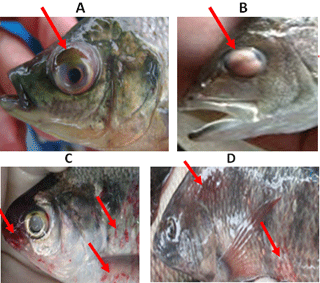

Picture Source Mad Fish Disease: 


Fish TB (MYCOBACTERIUM MARINUM), also called fish tuberculosis, fish tank granuloma, swimming pool granuloma. Related to human TB and leprosy.

MAD FISH DISEASE ... caused by STREPTOCOCCUS INIAE.
Recently reported from handling tilapia. Infection via puncture wounds.

SALMONELLA... over 1600 serotypes identified.
Infection by ingestion. Carried by many types of animals.

ERYSIPELOTHRIX RHUSIOPATHIAE, also known as erythema migrans, fish-handler's disease, fish poisoning, fish hand, sealer's finger, whale finger, blubber finger, etc.

VIBRIO infections. Several species can infect humans: V. ALGINOLYTICUS (wound infections), V.DAMSELA (wound/systemic infections), V. PARAHAEMOLYTICUS (gastroenteritis/wound infections),V.VULNIFICUS (wound/gastroenteritis/systemic infections). 


The below points are valid causes for concern for the USDA and why we believe that colleges will eventually play a more significant role in the certification and education process of aquaponics.


• Careful selection of sites for aquaculture farms. 

• Protection of adjacent ecosystems. 

• Active avoidance of conflicts with other users of the aquatic resources (e.g., fishermen) 

• Prohibition of chemicals (e.g.. as anti-fouling agents in net pens) . 

• Natural remedies and treatments in the case of disease. 

• Feedstuff from organic agriculture. 

• Fishmeal and - oil in feed derived from by-products of fish processed for human consumption (no dedicated "feed fishery"). 

• Prohibition of GMOs, neither in feedstuff, nor in the stock itself. 

• Processing according to organic standards. 

"According to a Consumer Reports magazine food labeling poll, some 74 percent of consumers are concerned about environmental pollution from “organic” fish. The poll also showed that 91 percent of consumers want contaminants in fish to be absent or present only at very low levels." See more information at the link below... 


Trinidad State College


The Trinidad State College in Colorado has a fantastic aquaculture program running, where they offer a 2 year accredited degree. They now want to expand their curriculum into an aquaponics certification and the ASC Magazine has been asked to contribute coursework to this process. We have a team of great writers who will be helping out and making suggestions to aid in the perfection of this aquaponic coursework. 


We are proud and happy to help out the college and we believe this is the right course of action in furthering the education process regarding the future of aquaponics.

If you would like to join the magazine please check out our main subscription page below: 


Cheers 

Victoria

Friday, October 11, 2013

Real Sustainability For The Future

Start Growing Your Own Food Now

As things really start to degrade across the USA, one thing becomes apparent; people need to make sure they have their own healthy food supplies readily available. 


I read somewhere that Monsanto is about to receive this years  Nobel Prize of Agriculture. 

How can this be? The way Monsanto creates seeds makes the very protein inside of the seed toxic to everything, including the human gut. 


If you haven't seen Dr Thierry Vrain's  video on this subject about gene mutation I suggest you watch it. He should know about seeds because he was once a scientist himself who studied nemotodes in the soil and the genetics of seeds.   The video is about an hour long but well worth the eye opening education he teaches. 


The only way people can really make sure their family are eating better foods is to grow their own. No matter what you see labelled in the stores, USDA Organic labels can mean just about anything now. I'm not trying to scare anyone but rather give people the facts. 


Just because you hear something from an official representative, doesn't mean it's true. How many times have we been told something from our local, state and federal representatives only to find out we have been lied to? Think about what is being told to you, do some of your own research and then draw upon a conclusion you feel is right for your family. 


Check out this site directly from the Federal Register about the National Organic Program-Sunset Process: Click Here


So what can a person do to make sure their food is safe? 


Aquaponics is a fantastic method of growing,  where a person can feel safe in knowing they are eating healthy foods. There are some things upfront you should know before spending money. 


I would strongly encourage people to educate themselves first about the biology and technology needed to maintain a succesful system. Too many times people jump in head first and quickly become frustrated with the process of aquaponics. 


It's not hard to manage aquaponics but don't spend wasted money, you  may need later for purchasing kits and fish. You don't need to spend a fortune to have a successful system either. Aquaponics can be interesting and educational for everyone. For the most part you can make the set up process fun for you and the kids. 


Figure out where you are going to be keeping the system first like a greenhouse, basement or garage. Then ask yourself some of these questions before setting up any system:  


  • How many people in the family will you need to feed?
  • How many grow beds and fish tanks will you need to sustain the family?  
  • What are the average temperatures in your area? 
  • Does it get really cold or hot where you live? 
  • What fish species will you be raising?
  • Can you get a healthy supply of local fish? 
  • Do you understand the science, biology and basic health care for fish?
  • What is the right sized water pump needed?  
  • Will you be using PVC or HDPE and what's the difference? 


If you haven't already read the Essential Fish Care In Aquaponics I suggest you take a look. The book gives readers a good understanding of the basic science and biology needed to raise healthy fish. It also goes over subjects like natural feeding, ammonia, nitrates, nitrites, water and oxygen which are also important. There are 13 good reviews and many people have found it to be a very useful guide to have around. With about 65 pages it's not a long read but a rather a worthwhile one. 


We also encourage people to sign up to receive the ASC Magazine each month. We will send you a  great online E-Magazine filled with information and stories from people who are growing food in the aquaponics industry. 

We also have a regular staff of people who are teaching others about natural products, permaculture, technology and other ways to grow food. 

The ASC Magazine is dedicated to teaching people how to become more sustainable. It is a good deal at $2.97 a month. The cost alone, makes this magazine an awesome price.  It will cost you less than one cup of coffee at Starbucks.  

You can subscribe here: Click this link 


Start growing your own food now. It is the only real way you can be sure of what you are eating. Take a look at some of the information on the community website when you have a free minute. Read some of the other information there we encourage all people to know about GMO and building real sustainable communities. 

Warm Regards

Victoria Kelley 


Monday, September 23, 2013

Lunch With Joel Salatin

A Lunch I Will Never Forget


On Saturday 09-21-2013 my husband and I were sitting at the back table inside of the grand ballroom at the Loews Ventura center. We were waiting to hear the Aquaponics Association speaker Joel Salatin come up to the stage. I knew who he was and I admired his work and passion.

We were in the midst of listening to a speech given by James Hollyer about food safety (which my husband already knew a lot about because of once being in the restaurant industry), a man sat down next to me in the empty chair. No big deal just move your stuff over a bit and let him have some leg room Victoria.

At first I had no clue who he was and asked him "Do you have enough room to sit?" as I moved my notepad over for the man to have some extra space. "Yes I'm fine thanks." The man pulled out his notebook and started to make some notes about the lecture being given.

Once the lecture was over, Casey told the audience, lunch was being served in the foyer and there would be a 30 minute break. I still had no idea who was sitting next to me until the man stood up and I could see his name tag and read Joel Salatin. I then happily introduced myself along with the ASC Magazine and asked him if he would consider writing us an article at some point. I then left the business stuff alone and decided to have a NORMAL conversation with Joel Salatin.

I asked Joel how did he like the Tucson heat? He said he wasn't going outside for that reason (96 degrees on Saturday) and I agreed that was a smart move. Then we moved into conversations about the Australian heat, what part of Australia I was from, how rich the mining was in Australia, the changes in the land with fracking, bad erosion in New Zealand and how much Joel really enjoyed Australia and New Zealand. "I really love that Australian accent, it's so refreshing." he said.  Did I just score some brownie points on the accent? Or maybe we were having a great conversation because I treated Joel Salatin just like a regular guy.

Mike and I went off to get some lunch and came back to the table. Joel came back with his plate and sat down with us and the conversation started up again with Joel, Mike, me and Glen Martinez from Olomana Gardens.

Glen already knew Joel from other conferences and there was some reminiscing and laughs between the two. You know Joel Salatin is a pretty nice and very approachable man.  The lunch conversation started out with farms and the deadly bacteria's that now exist in food like E-Coli and Listeria. There were all kinds of comments back and forth where these bacteria came from and the whole food safety speech.

In chimes the young woman at the table "I just love your work and I have all of your books Mr. Salatin and we are big fans," with the big eyes and tilted head smile, as she ate 2 lettuce leaves and 3 slices of tomato for lunch. (The rest of us were eating a good lunch composed of rolls, meats, salads and cheesecake.)  Joel smiled politely and gave a very quick "Thank you, that's very much appreciated" and moved back to the conversation with myself, Mike and Glen.

Most of the time if you treat famous people like you have known them all your life, you are more likely to have a great conversation with them. Many of them don't want to be ogled over, they just want to be treated like everyone else.

Growing Up and Remembering

I made a few comments about how it was when I was growing up, "I was raised on a sheep farm with over 1500 head of sheep. I used to dislike it when the cattle trucks came in and hauled the sheep away. They used to cram the sheep in with their necks sticking up high and all squashed together. Hauling sheep for hundreds of miles in that condition."

"My mother had a big vegetable patch and we used a lot of dried out sheep poop in the garden. We also had chickens, ducks and horses. I never even knew what bacteria was and no-one ever was sick from eating our vegetables. The farms used to trade and share produce and the chickens would run loose in the garden and no-one ever considered separating one animal area from another. They just all got along" There were heads nodding and comments made about their farms being about the same, as they remembered.

I then said "I never had an allergy until I came to live in America. Up until then I was free of swollen eyes, sensitive skin and sinus issues." Again there was more head nodding and uh-huh noises made as we ate lunch.

When Joel Salatin gave his speech to the Aquaponics Association one of his opening lines was "That some of us grew up on farms, never even knowing what the word bacteria meant." I just smiled because I guess what I said resonated with him.


I was very glad I had the opportunity to meet and have lunch with Joel Salatin. He is just an average, down to earth, easy going man. He has a common sense approach to farming, bacteria and getting back to the land. I totally agree with what he says too.

Our society has become so disconnected that we are afraid of germs, bacteria and we have separated everything that helps the natural cycles of things work the way they are supposed to. I have to say it, official personnel and science don't know everything, as a matter of fact they have got a lot wrong. You only need to see GMO to know it's all screwed up. Joel Salatin lets his pigs go wild in his compost pile to make it better. I am sure food safety people would have a heart attack over this.

You know what? Our bodies are made up of thousands of different bacteria and Joel is right about mixing things up. It is the separation of this animal from the other one that causes the problems. Cows were supposed to go into the corn occasionally, just like my mothers chickens went scratching around in her vegetable garden patch. You are supposed to get dirty and have bacteria on your hands, clothes and body. How can we ever fight infections if our bodies don't know some of these bacteria's?

The Moral of The Story: 

Be real with people. Use a more common sense approach to life. Have good down to earth conversations. You never know how many people you can reach with information about aquaponics, gardening, permaculture farming and living healthy lives.  I learned something wonderful from Joel Salatin...just be yourself. 


Thanks for the memory and I hope we can do it again one day!


Monday, September 16, 2013

Fish Diseases And State Regulations

Why All The Rules Over Raising A Few Fish? 


The last post that we placed on this blog raised a few questions within the community along with a few heated words.  For the most part I understand that most people are fed up with all the "can't do, do you have a permit and get all your ducks in a row first." It's a pain and none of us really like fines or the fact we feel our lives are governed by laws. Seriously, I understand these feelings too.

Pointing out to people that each State have their own rules and regulations about raising and keeping fish is a responsible thing to do, especially when you have a community of nearly 14,000 people on Facebook. (None of the people in our community are paid fans, promotional coupon joins or any other way to get likes on the page. Our community is made up of real people with all organic searches who have genuinely joined the page.)

At this point, I feel I have a responsibility to give people the correct information they need, to make informed decisions about keeping and raising fish in their state. I am certainly not here to tell anyone what they can or cannot do and that's definitely NOT the point with aquaponics fish.

Bacteria, Viruses and Parasites

There are different bacteria's, parasites and infectious diseases, regarding fish and farming. Mentioning these problems to people is also a responsible thing to do. (This month in the ASC Magazine we highlighted the EWS technology from OriginOil, which can help reduce these issues with aquaculture farms.) It is even possible that wild fish can contract diseases from other people flushing their poor dead goldfish down the toilet or releasing a fish into a local lake. If the fish were sick, that toilet flush could eventually cause the native species to become infected with bacterial problems.

No-one says your fish will have any problems but what if you did buy some fingerlings that were sick would you know what to do to treat them? This is why it's a wise decision to check out the breeders credentials first.

NO...we are not trying to frighten you, we are only asking that you consider questioning your fish purchasing sources first. Many breeders have healthy clean fish and these are the people who are usually state board certified, BUT it will only take one under the table seller to make things difficult.

Viral Hemorrhagic Septicemia is a deadly infectious fish disease. It afflicts over 50 species of freshwater and marine fish in several parts of the northern hemisphere. VHS is caused by the viral hemorrhagic septicemia virus (VHSV), different strains of which occur in different regions, and affect different species. This link will direct you to a PDF with more information about the infection.


In the end purchasing any fish for aquaponics, comes down to you. 

It is your aquaponics system, your fish and your responsibility. We have provided what we feel was good researched information for you to take the next step and make better informed decisions. 

We wish you many happy years in raising happy, healthy fish!

Warm Regards

Victoria 


Friday, September 13, 2013

Aquaponics Fish and State Regulations

Why It's Important To Know The Regulations

Most of us do not like regulations or paying for licenses and yearly fees. I totally get that because it is a pet peeve for me too. However when it comes to buying, keeping and selling of fish with aquaponics there are good reasons why everyone needs to understand the state laws. 

Because Aquaponics is a fairly new way to grow produce and proteins together there are a lot of regulation loopholes at this time. Some people will take advantage of this to make a quick dollar while jeopardizing the safety of others.


This month the ASC Magazine started a series of articles about raising fish in aquaponics, what types of fish and state regulations. ASC contributing writer Adam Cohen (who is also Vice Chairman and Director of Education of the Aquaponics Association) started the series off, with the state laws in Texas. Click here to read more about the article:  

One of the things the Aquaponics Association does, is to help people with the education process regarding aquaponics. Being a part of the Aquaponics Association also tells other people that you understand these state requirements and will follow the rules. 

There are people on the internet who will tell you that you can raise fish, sell fingerlings and make lots of money in the process. That's not exactly true, especially if the issue of state permits and regulations is never mentioned or just lightly touched upon. What will eventually happen to other breeders who do follow the regulations, is that loosely worded behavior like this, will result in serious clamp downs on everyone else involved in the aquaponics industry.

Before anyone considers buying fish, you need to find out if your state will even allow you to keep certain species at your home or place of business. Find out what the permitting restrictions are first or what species of fish you can keep. The link we are providing,  has the phone numbers and addresses for every state from the US Fish and Wildlife service. CLICK HERE

Tilapia Are Considered An Exotic Species

Many USA states have strict guidelines you have to follow first before you can keep and raise them. In countries like Australia you cannot even handle them. It is against the law.  


Important Information You Should Know First 
Some internet sites like Craiglist and Pennysavers have people openly selling fingerlings to the public. This is perfectly legal if the breeder is State Certified and carries the special permits to do so.

BEFORE YOU BUY ANY FISH you must find out about the breeder and their permits first. The first time YOU are caught transporting live fish from an illegal breeder, the responsibility is placed back on you! Huge fines or even considerable jail time could result. Additional felonies could be imposed, if the fish you are transporting are infected with bacteria. Therefore you will need to know if there are any parasites, bacteria or other infectious problems with the fish you are buying off the breeder.  Check the breeders credentials first with the state or see if there are any complaints filed against the seller.  

The biggest concern which the wildlife services have, is releasing some of these introduced species back into USA lakes and streams. Tilapia are prolific breeders and if released into natural waterways, they could quickly take over some of the native species of the local areas. For Tilapia this applies mostly to the warmer waters in the southern states but Tilapia can reach sexual maturity very quickly, so there is a possibility of the young finding their way around.

I would like to mention that the laws apply for different fish species which can also be used in aquaponics systems and not just Tilapia.

These rules and regulations have already been set up from each state around the USA. We are not here to tell you what to do but rather point out there are laws. Here are just some of the state regulations below:

Indiana Laws:       Click on this link
Texas Law:          Click on this link
Iowa Law:           Click on this link 
Maine Law:         Click on this link
Minnesota Law:   Click on this link
Wisconsin Law:   Click on this link
Tennessee Law:   Click on this link
North Carolina:    Click on this link
Colorado:            Click on this link

The illegal introduction of any fish into any Maine water is a Class E crime, punishable by fines of up to $10,000. That's a lot of money even if you were not aware of doing something wrong. So before you think you are getting a good deal off someone with 100 fingerlings, that good deal could quickly go sour if you end up with fines or even doing time. All of these headaches for transporting and harboring illegal species, can simply be avoided by doing your homework first!

I have also mentioned these legal requirements in the back of my book the "Essential Fish Care In Aquaponics" because I believe this is very important information for people to know first.

Lesson: Buyer beware!   (Caveat emptor) 

Warm Regards

Victoria


Tuesday, September 10, 2013

ASC Magazine and OriginOil

The EWS Technology From OriginOil

This month in the ASC Magazine we are highlighting an amazing story from OriginOil. 

Sometimes in the world, there are incredible inventions which can change lives for the better and increase business production. OriginOil wrote an amazing article for the ASC Magazine about their EWS technology. 

Nicholas Eckleberry is the inventor of the EWS technology along with being co-founder of OriginOil. Nicholas has authored or co-authored thirteen patent applications in the field of algae production and commercialization.


So exactly how what does this technology work? 


It takes filthy ammonia, bacteria ridden water and turns it into usable clean water. The water from pictures in the article went from green to clear, which is great news if you want to have healthy fish. We received a photograph from the company showing a man drinking the water after it had been cleaned. 

For the aquaculture industry this can easily revolutionize how they keep their ponds clean. The majority of our fish now comes from aquaculture farms. The problem that many farmers face are serious problems with ammonia, bacteria and other nasty things in the water. Many fish die and it can create a huge problem for the industry. The EWS technology can eliminate these issues. 

OriginOil are already showing the world that we can use algae as a form of oil and now they are showing the aquaculture industry, they have a solution to the problems with keeping fish ponds clean. The technology is quite remarkable. 


If you would like to read more about September's cover article please click on the link within the cover picture or you can go here

I could also see how this type of technology could help third world countries have clean drinking water. It can take out bacteria and parasite problems that countries like India have with their water. I can see all kinds of great uses for the EWS technology. 

As a matter of fact I was contacted by a man from India who wanted to know more about this type of system for his town. He had seen a highlight of the article and he was very interested to know more. Most of us will never know how precious a clean drink of water is in the western world, but yet it is still a huge problem in places like India. 


Warm Regards

Victoria 


Monday, August 26, 2013

Essential Companion Guide To Organic Gardening

Companion Guide To Gardening?

I recently wrote a book which I felt could benefit many people about growing from the ground. "The Essential Companion Guide To Organic Gardening," is designed for the earth bound gardener. The book has only been on Amazon Kindle in the last few days.

Many of us still prefer the old fashioned way of putting our hands in the soil to garden and I get that because I thoroughly enjoy watching produce grow in the earth too. Unfortunately some of us are not aware of what is happening to our soil from incorrect ways of gardening. Using pesticides, chemicals and other products can eventually harm your health and vegetables.

Some beginners may not be aware of all the wonderful unseen things that happen inside of the earth. There are amazing little creatures that exist especially to help the earth stay fertile and healthy. Humans have become so used to using sprays and weed killers that many just don't know about the more natural methods that work even better.

To pick up your copy today off Amazon Kindle Click on this link  or click on the book below.


This book is designed to help people understand soil, organic gardening and more natural ways to grow produce better. It shows people different ideas into changing pH and using more natural methods rather than reaching for the hardened chemicals. These are simple suggestions which can further enhance the growing in just about any soil condition.

I don't know about you, but it's time humans realized that chemicals and pesticides are poisoning the ground, the earth and ourselves. We cannot keep putting these toxins into the ground and water, without repercussion from nature. 


The Mayan and Mesopotamian people ruined their soil because they didn't understand the balance needed to maintain good growing conditions.

The microbes and bacteria that live in the soil are crucial to human survival. Most people are not even aware of the balance these microscopic creatures play in our lives. If they cease to exist then so do we. Without them, we cannot grow food properly or even draw essential nutrients from the ground that we need to survive.

I will show you how to increase the bacteria in your soil. I will teach you alternative and natural methods from turning sandy soil into productive and beautiful healthy growing land. What about thick clay soils?..I will show you how to change the texture into a more productive and usable earth.

It's not to late to turn back the hands of time....we all can do it together!
It will require, sweat, shovels, rakes and dedication.

Join Our Facebook Community Here

Happy gardening everyone!

Victoria