Pages

Thursday, July 30, 2015

Energy Efficient Greenhouses For Growing Food

What Kind of Greenhouse Do You Want To Build?

There are all kinds of different styled greenhouses people can build to house their aquaponics systems and grow healthy foods. Winter can be a challenging time for many people who live in the Northern Hemisphere. We have to deal with maintaining a good water temperature, heating the greenhouse and keeping the cold out to grow food. 

Our family live at 8000 feet in the Colorado mountains. That means freezing temperatures and high winds during winter. In our area we need a greenhouse that can take the winds and believe me it can get pretty rough here at times. Our family already tried the hoop house build (below) and the wind tore it to shreds after a few months. 


Maintaining natural heat throughout the greenhouse is also important. I want to have a greenhouse that will not break the bank but allow me to grow throughout the year. The picture below shows the winter sun position in our area. As you can see the sun is fairly low in the sky on a southerly aspect. We took this picture in January when the lake was totally frozen over.

If you live in the Northern Hemisphere growers will need a Southerly aspect for their greenhouse position to maintain the best heating. The longest side of the greenhouse should get the most exposure. For anyone living in the Southern Hemisphere, you will want to place the greenhouse towards the North. 


The graphic image above gives people a good idea of the sun's position during winter months in the Northern Hemisphere. 

Walipini's And Earth Sheltered Greenhouses

Walipini means place of warmth and these types of natural earth style Greenhouses have been built in South America where people were growing bananas at 14,000 feet. That's quite an amazing achievement when you think about it. 

A Walipini is build inside the earth and you may need to hire someone to excavate the long trench. Walipini's are usually built 6 to 8 feet down into the ground and can be as long or short as you need them to be. You can re-use the excavated dirt to create earthbags to reinforce the side walls if you want a secure bunker style.


If you build your walipini correctly it should maintain a healthy temperature of approximately 70 degrees even on those cold wintery days. If you live in an area where space is not a problem check the position of the sun first, then build the length of the Walipini facing the winter sun. The more sun exposure the better it will be for heating purposes. 

Will your Walipini have a plastic or polycarbonate roof? Plastic is obviously cheaper but it will not last as long, so do you put most of your money into a good roof and framework or wait a few years to change it out? I guess that will depend on you and the amount of money you have to spend. I know of a family who used Dura-skrim as a cover for their roofing materials.

In my area of CO, I would much rather go for the secure roof materials (polycarbonate) and framework rather than have a disaster happen and lose plants due to flooding or a cave in.  

Placing a walipini on sloped land is a better idea because it will allow for any rainfall to run away from the walipini instead of flooding it out. Walipini's are ideal builds for people who live in Semi-arid desert conditions like Texas, Utah, New Mexico, California and Colorado. Lower rainfall areas work better because too much water can be a problem. If you live in Florida a walipini is probably not going to work for you. 
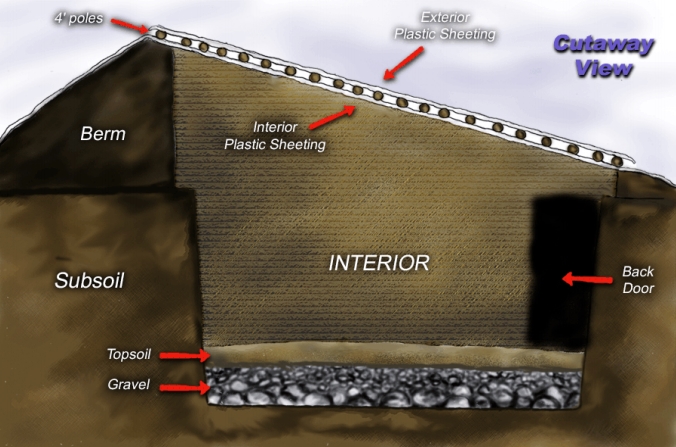


I have some plans here for you to keep which will teach you to build a Walipini: 

ALSO

Take a look at this great PDF created by the University of Minnesota Extension Service 
On cold climate greenhouses: 


Passive Solar Heated Design Greenhouse


Saving money on heating any greenhouse throughout the winter is crucial especially when millions of people are financially strapped for cash. Having a reliable greenhouse to grow food during the cold months is even more important. I would like to offer people the below plans which comes with building materials needed for the above passive solar heated greenhouse design. 

It was put together by the Bradford Research Center College of Agriculture, Food and Natural Resources and I love this design because black water barrels are used to heat this particular greenhouse. 

This type of greenhouse is ideal for people who cannot dig down to build a Walipini but want a passive solar greenhouse. Check out the below link for the plans: 


Having an energy efficient greenhouse to grow food can be a lifesaver for a family who wants a more sustainable lifestyle. It can house your AP System, grow smaller tropical plants you normally couldn't grow in the North and even offer a warm shelter for animals.

Warmest Regards

Victoria


Wednesday, July 29, 2015

Ethoxyquin In Animal, Fish and Human Food

Ethoxyquin Is Actually A Registered Pesticide

For a long time people may have looked at their fish food ingredients and noticed the word 'antibiotic' on the packet and never really given it a second thought. Most will think it's there because of the fishmeal in the food and antibiotics help to keep the food safe.

The 'antibiotics' are just there to preserve the shelf life of the product and to stop the food from going rancid. The actual truth of Ethoxyquin is something a bit different. This chemical is actually a registered pesticide on the EPA website and is owned by Monsanto. The beginnings of the chemical Ethoxyquin is even more interesting; as it started life out to prevent rubber from cracking because of antioxidant efficiency and stability properties. The chemical was then refined down and added in food as an antibiotic.

People really should be asking why is a pesticide being used in ANIMAL, FISH and HUMAN Food? 


“Ethoxyquin is rapidly absorbed from gastrointestinal tract of laboratory animals like rats and mice. Peak blood concentration of the compound is observed within 1 h. Distribution of EQ in animal body is similar when it is administered orally and intravenously." 

Other names for Ethoxyquin are: Stop Scold,  Santoflex, Quinol and Santoquin. Monsanto uses it because it’s cheap to produce and because it protects lipid peroxidation and stabilizes fat soluble vitamins (A, E) in animal feed. 

“Small amounts of parent EQ were detected in liver, kidney, and adipose tissue and fish muscles. It is excreted predominantly as metabolites via urine.”

The above quote is something people in the AP industry will be more interested in because the produce is grown in water and the fish urine-poop helps everything work in the symbiotic cycle. You can download the below PDFs for more information on the studies regarding Ethoxyquin.  I have more science studies but this is a good start.  


Download The PDF regarding Ethoxyquin here:


Aquaponics can be a very healthy way to grow food and I totally support growers and farmers who are producing this way. However can we still say the produce grown in AP is totally organic when pesticides are being found in fish food?  It's obvious from the above links Ethoxyquin is a registered pesticide and that alone is cause to question what fish are eating.

Anyone who is growing food in Aquaponics needs to look more closely at the food they are feeding fish. Check the labels on the back of commercial food packets and look at ALL the ingredients which should include preservatives and antibiotics. 

There are some good brands of fish food out there but you have to look around. The Aquaponic Source sells a pretty good brand and they have all their ingredients listed on the website.

If you are selling fish food online or in a store, it is your responsibility to be posting ALL the ingredients. The EPA has guidelines they expect sellers to follow so checking out their website might be in order. Consumers have the right to know what they are buying and feeding to their animals. If you do not see these two ingredients listed on a seller's website, don't buy the food until you know what type of chemicals are being used as antibiotics. 

My Questions Regarding Ethoxyquin Are These:  

Can this pesticide be found in produce being grown in aquaponic systems? The roots intake the much needed nutrients from the water, so it stands to reason the plants may also be ingesting Ethoxyquin. That sounds reasonable don't you think? After all Glyphosate from Roundup is now being found in waterways, drinking water, breast milk, food and soil. So can the same be said about Ethoxyquin?

Could Ethoxyquin be a good reason why some people have problems with their fish health? Some people have complained in the ASC community their fish just up and died for no particular reason. Could it be the fish are ingesting Ethoxyquin from the food and over time the chemical build up in their bodies, causes them to die? Most of us already know fish are extremely sensitive to chemicals so this could be a valid point. 

Can a pesticide like Ethoxyquin affect the water in the AP fish tank? Could this also be the reason why so many people become frustrated with high pH problems? If a person has to rely on city water for their fish, there are already chemicals in the water but could Ethoxyquin affect pH? Has anyone ever questioned this or done testing on this pesticide? 

These are good questions to ask because more people are becoming painfully aware of the amount of chemicals in water and food. Not everything we have been told is the truth and sometimes bait and switch tactics are used on the public to convince them pesticides, additives and antibiotics are safe for human consumption. 

"How could we have ever believed that it was a good idea to grow our food with poisons?" -Jane Goodall


Over a year ago I wrote a book called "Essential Healthy Fish Food In Aquaponics" where I named many different chemicals, used in fish food and other animal products.  For instance SOY and CORN added into fish food; do you know about these two foods your fish are consuming?

Nearly 97% of Corn and Soy being grown in America is GMO. If you consider the Glyphosate from Roundup on the seed itself and then look at the ingredients in your fish food, this might be one of the reasons your fish become sick or die off occasionally.  Think in terms of long term chemical build-up and not so much about the fact it's GMO then you get what I'm saying here. 

Soy is also washed in a petro-chemical called Hexane 


n-Hexane is a chemical made from crude oil. Pure n-hexane is a colorless liquid with a slightly disagreeable odor. It evaporates very easily into the air and dissolves only slightly in water.

n-Hexane is highly flammable, and its vapors can be explosive.  

Makes you think about what you are eating now doesn't it....check your labels before buying fish food because that old saying of Buyer Beware is also true about the food we may be feeding the fish. 

Warmest Regards 

Victoria 


Saturday, April 11, 2015

Become an Affiliate for the ASC Magazine

Get Involved In The Future


Over the past 2 years the ASC Magazine has been delivering a monthly magazine to readers from all over the world. The magazine has grown to the point where we need more help from industry leaders, business owners and the public. 

We have been publishing stories from backyard growers, commercial growers and gardening fanatics. The magazine has also become more interested in publishing white papers and studies from universities, educators and people with experience in aquaponics, aquaculture, agriculture and permaculture. This is something our readers have asked us for so we are giving them what they want. 

We are also including more stories and advertisements from greenhouse manufacturers, lighting specialists, solar panel companies, aquaculture suppliers, suppliers of all kinds of growing equipment and other similar companies. 

The magazine has reached a point where we are now sharing some of what we do with other interested people who want to help us spread the word and make some money on the side. 

We are inviting commercial growers, business owners and interested parties to become an affiliate for the ASC Magazine. 

The ASC Magazine is now offering the following incentives for Lifetime Conversions: 


  • The magazine affiliate program will be offered through Clickbank ( a 3rd party verification company.  

  • Your percentage of selling the magazine will be sent to you in the form of a check or direct deposit, directly from this company. They will let you know the options available to you.

  • We will provide the banners and other tools (if need be) which will enable you to make money.

  • The ASC Magazine will make up the pre-made E-Mails if you need help with that.

  • The Minimum payout will be $20.00 per conversion of the Lifetime Subscription.


If you would like to learn more please E-Mail Us for more details:  Click Here 

This is a great opportunity to make money and help us spread the word to others. The ASC Magazine is going to keep on reporting the changes, advancements and industry leaders because Aquaponics is set to be one the futuristic businesses by the year 2030 according to Business Insider.


"Aquaponic fish farmer: In 2030, populations of wild fish are disappearing — so new production methods like aquaponics will step in to replace fish that we can no longer catch in the wild. Aquaponics combines fish farming with gardening, where plants grow over water to cover its surface, while fish live below. The plants return oxygen to the water, and the fish produce waste that provides fertilizer for the plants."


Happy Gardening Everyone

Victoria Kelley 
ASC Magazine Editor 


Tuesday, March 24, 2015

So What About BioFilters In Aquaponics?

Ammonia, Nitrates and Happy Bacteria


It's a known fact that very few plants like any sort of ammonia on them. As a matter of fact have ever seen how your lettuce looks after the family dog has urinated in backyard vegetable patch? A few days after Duke marked his territory on your lettuce, it looks all burned and wrinkled. Too much ammonia is very bad for those lovely green plants. 

The challenge in aquaponics is to reach the perfect balance between ammonia, nitrates and bacteria. I often see these questions asked in our Facebook community regarding ammonia, pH and water. 

The reason why I encourage people to read our magazines, is because we have writers who answer these very important questions people ask often.  I have picked some of the most clever and informative writers to answer reader questions. These people have some very cool ideas and know what they are doing when it comes to aquaponics.

Vlad Jovanovic is an excellent writer when it comes to giving answers to our readers. He is also a wealth of information in regards to aquaponics. Every month he handles the readers questions and answers them to perfection. Actually he goes above and beyond in his research and we are thrilled that people have been so pleased with Vlad's Column. 
  
In aquaponics systems plants do not need ammonia to be healthy. Plants need Nitrates to grow not Ammonia. Yet ammonia is still a problem many people have in their systems. Fish cannot handle a lot of ammonia because it is toxic to them.

So what can you do to make everything work better in your AP System? 

Some of the same principles used in aquaculture should be applied to aquaponics because fish health is important too. What we are trying to do in aquaponics is create healthy bacteria and have a system with very little ammonia in it. Having a biofilter installed in your system is crucial for the best animal and plant health possible. 

Making your own biofilter doesn't have to cost you a fortune to make. They can be easy to create and I have seen some great DIY creations on YouTube. Here is just one video below you can look at.


Another good thing about having a bio-filter is that it doesn't have to be a huge over the top design to be effective in your AP System. 

BioFilters have been called a couple of other names people may know like swirl filters, trickle filters and moving bed filters. You may have also seen a containment system working on a home backyard Koi Pond. For anyone who knows about breeding fish, filters are essential for maintaining their good health. This is pretty much the same principle that needs to be applied in aquaponics too.

For anyone selling AP systems they should be encouraging you to either buy a biofilter for your system or learn to make your own. If the person isn't suggesting a workable biofilter added to your AP setup, then find someone else who recommends this. If anyone says you don't need one, walk away and find an instructor who recommends this type of set-up. Even a small home aquarium tank, has a filtration system attached to it. This helps keep the ammonia levels down and provides cleaner water for the guppies or goldfish. 

Download this PDF for some excellent advice from the University of Arizona on a Biofiltration‐Nitrification Design Overview Overview by James M. Ebeling, Ph.D.


And here is another one you can read up on: Fish farming in recirculating aquaculture systems (RAS) by Louis A. Helfrich and George Libey, Department of Fisheries and Wildlife Sciences Virginia Tech

Here is just a part of the read in this download on Biofiltration: 

The biological filter (biofilter) is the heart of the RAS. As the name implies, it is a living filter composed of a media (corrugated plastic sheets or beads or sand grains) upon which a film of bacteria grows. The bacteria provide the waste treatment by removing pollutants. 

The two primary water pollutants that need to be removed are:  
(1) Fish waste (toxic ammonia compounds) excreted into the water and 
(2) Uneaten fish feed particles.

The biofilter is the site where beneficial bacteria remove (detoxify) fish excretory products, primarily ammonia.  

So as you can see it is a crucial part of running a healthy aquaponics system. Smaller counter top AP systems can still have biofilters which would be more like the filters you buy for aquarium tanks. 


You have fish to care for and they rely entirely on your expertise to exist. Care for their health in the best way possible by installing a biofilter in your AP system.  Sign up for some of the most updated and best information around by joining the ASC Magazine today. Subscribe to the Lifetime Membership. It's a one time fee and then no more debits. 


Warmest regards 

Victoria Kelley

Editor of the ASC Magazine


Thursday, March 19, 2015

Do You Grow Your Own Food?

The Dilemma Continues Over Fresh Foods

So many people have now become aware of the big corporations who are growing our food and there are way too many mixed results to ignore the problems anymore. There are all kinds of protests, demands for better labeling with consumers walking away from the big supermarket chains. This is definitely making big corporations pay more attention to what people want to see more of in the way of fresh foods.

Americans have always been backyard and community growers and were huge advocates for Victory Gardens from WW1 up until the mid 1960's. SO What happened to us at that point in time?

Big corporations took over the mom and pops farms that had been owned for generations, they introduced their own version of growing and promised to eradicate hunger and starvation within our world. Some forty plus years later we are still waiting for the starvation promise to be gone because if anything, it looks worse than ever before. 

What we now see in supermarkets are cans, packets, plastic containers and jugs all filled with foods that have questionable ingredients in them and consumers are now voting with their feet. 60% of Americans are now eating food that is not fresh but is actually placed in containers for supermarkets. 

Our water is contaminated, our soil is quickly becoming depleted of minerals, our oceans are being fished out and our food is questionable with things like GMO and additives. People are fed up. 

The Tide Is Changing

The big trends that seem to be making a comeback are Farmers Markets where the consumer can ask questions to the grower about sprays, pesticides and other things on the fruit and vegetables. People want to connect to local growers and farmers and support their efforts. 

Growing locally just makes perfect sense to most people. The food isn't trucked in 1500 miles away and tastes a lot fresher. Who wants to eat apples that taste like cardboard anyway? 

Co-Operatives are becoming huge because they promote local growers, farmers and proudly advertise natural organic foods. They encourage the people who are part of the Co-Op to keep on supporting local. 

Consumers are turning their backs on companies who will not take certain ingredients out of food like High Fructose Corn Syrup (Mercury Derivative) or Azodicarbonamide (found in bread and other products). People are quickly losing faith in big corporations and we are now taking the process of growing food more seriously. 


*The above article is referring to big companies like Campbells who have promised to remove some very questionable ingredients from their food and deliver a healthier product.

Another Trend On The Increase 

We are finding more consumers who want to try and grow their own food instead of having to rely on big agriculture and food corporations who tell us "It's all good, there is nothing in our food to worry about." People are finding that statement very hard to believe. Actually big profit losses with corporations like McDonalds proves consumers are paying attention. Seriously who wants to eat Chicken Nuggets with plasticized fillers in the food?

You can check out McDonalds website for more food ingredients.  Are your ingredients 100% pure? "Pure" is a word that means different things to different people. This is a direct quote from their site.

What the ASC Magazine is trying to do is ask colleges, teachers and people who are growing food to participate in our magazine. Share your stories, experiments and even your personal victories with growing food. We want to help you publish your experiments and home grown experiences. 

We don't care if you are doing this through aquaponics or permaculture because either way you are helping to educate other people who are desperately searching out more information. 

This is the link to sign up and receive your FREE Copy of the ASC Magazine. 


If you would like to share a website or blog, let us know. We can share your information and Vice Versa. We would be happy to help out small businesses and professionals. Our magazine feels this is the best way to bring more people together by supporting other Professionals and Growers in the industry. 

Here is the link to writing an article for the ASC Magazine. We are looking forward to hearing from you.


Happy Growing Everyone

Victoria Kelley
ASC Magazine Editor